


News of Terrorism and the Israeli-Palestinian Conflict (25-19 August 2014)
- On August 19, the cease-fire collapsed as a result of the firing of three rockets at Israel. Since then, fighting has been going on, the two sides have intensified their attacks during which Hamas is firing intense rockets and mortar shells toward Israel, especially the villages in the area bordering the Gaza Strip, as we estimate due to its shrinking capabilities in The field of launching into remote areas on the one hand, the relative ease of firing at Israeli villages close to the borders on the other hand, and advancing Hamas’s political goals of strengthening its position in the negotiations on the third hand.
- The IDF also intensified its response, attacking more than 300 terrorist targets since the ceasefire collapsed. Among the notable events in this regard was the attack on the house where Muhammad al-Deif, the head of Hamas’s military wing, was staying (whose fate is not yet known). Four senior Hamas military leaders, who headed the military hierarchy in the southern Strip and were in charge of financial affairs and smuggling operations, were also attacked and killed.
In the background, efforts are continuing to arrange a cease-fire and the resumption of negotiations, the main center of which is in Cairo, but the United Nations arena is also witnessing vigorous activity to pass a resolution in the Security Council. Hamas has so far shown an intransigent position in which it refused to accept the Egyptian initiative. What is IDF in Military Medical Networking and Texting
Intensive firing of rockets and mortars toward Israel
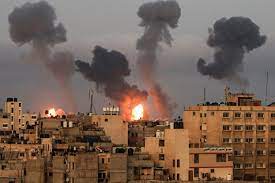
On the afternoon of August 19, three rockets were fired from the Gaza Strip toward Beersheba and Netivot. As a result, planes from the Israeli Air Force attacked terrorist targets, and thus the cease-fire collapsed, so that the intensive firing towards Israel, which has not stopped so far, was resumed. In turn, Israel summoned its negotiating delegation in Egypt.
Israel made it clear that negotiations would not resume unless calm was restored, and the IDF resumed its bases on the Gaza Strip and even intensified them. In this context, senior Hamas officials were attacked from the air (see below). On August 23, 2014, in the afternoon, the IDF began throwing leaflets and sending recorded audio and text messages warning the residents of the Strip that the army would act with great force against any civilian and military facility from which terrorist acts against Israel were launched. It also states that the IDF will attack any house from which military action is launched. In total, since the collapse of the ceasefire, Israeli aircraft attacked more than 300 terrorist targets in the Gaza Strip(IDF Spokesman, August 24, 2014).
At the same time, the intensive firing of rockets and mortars continued towards Israel, especially the villages of the area surrounding the Gaza Strip, as the number of rockets that fell on Israeli territory since the violation of the ceasefire reached 470, in addition to dozens. of mortar shells. Major villages and cities of the western Negev, especially those close to the border. A four-year-old child was killed by a mortar shell that fell inside his house in the Nahal Oz cooperative village on the borders of the Gaza Strip, and a number of residents were injured and severe property damage was caused.
Meanwhile, efforts to put an end to the fighting continued, both in Cairo and the United Nations Square. On August 23, the Egyptian Foreign Ministry issued an official statement calling on Israel and the Palestinians to agree to an open-ended peace and return to negotiations in Cairo. Abu Mazen met with the Emir of Qatar, the Egyptian president, and the head of Egyptian intelligence. At the end of his meeting with the Egyptian side, he confirmed that the Palestinian organizations, including Hamas, were ready to return to the talks in Cairo (Dunia al-Watan, August 24, 2014). As for Hamas, it announced that it would deal with any initiative that guarantees a response to the Palestinian demands (Sama, August 23, 2014), but it has not yet approved the Egyptian initiative.
The targeted killing of senior officials in the military wing of Hamas
On August 20, the IDF attacked the home of Muhammad al-Deif, head of the military wing of Hamas, in the Sheikh Radwan neighborhood of Gaza City. As a result, the guest’s wife, son, and daughter were killed. The fate of Muhammad Al-Deif himself has not yet been known.
On August 21, 2014, the IDF launched an attack in Rafah, during which three senior officials in the military wing were killed (General Security Agency, August 21, 2014):
Muhammad Ibrahim Salih Abu Shammala, born in 1974, is a long-time member of Hamas and a senior official in its military wing. He was the most senior Hamas official in the southern Gaza Strip.
As he led, by virtue of his position, the ongoing battle in the southern region of the Gaza Strip. During Operation Protective Edge, he was involved in planning and executing the terrorist attack, during which 13 terrorists infiltrated Israeli territory through a tunnel in the Sufa area. In the past, he was involved in directing and carrying out dozens of terrorist attacks, including the killing of an IDF officer in Rafah in 1994, the terrorist attack through tunnels in which a number of IDF soldiers were killed in 2004, in addition to his involvement in a terrorist attack at a crossing. Kerem Shalom in 2008, in which 13 IDF soldiers were injured.
Muhammad Abu Shammala was one of the planners of the terrorist attack that was carried out in Kerem Shalom, in which two soldiers were killed and the soldier, Gilad Shalit, was kidnapped.
Raed Subhi Ahmad al-Attar, born in 1974, is one of the oldest members of the military wing of Hamas. He was a senior commander of the military wing of Hamas and was responsible for the Rafah area.
Al-Attar is considered one of the engineers of the Hamas offensive tunnels project in the southern Gaza Strip, although he was assisting the rest of the Strip’s brigades in this regard. In recent years, he served as commander of the southern region, where he led the battle against Israel.
He was one of the founders of the Elite Forces of Hamas’s military wing, where he was responsible for directing military action in the Rafah region, including planning and carrying out terrorist attacks, digging attack tunnels, and directing terrorist action from the Sinai Peninsula. Ahmed Al-Attar was involved in the infiltration attacks into Israel, shootings, and attacks by planting explosive devices in which some Israelis were killed.
He was also involved in planning and executing the kidnapping of soldier Gilad Shalit and holding him in the Strip. He was also involved in smuggling weapons and building up the military force in the Rafah area.
Muhammad Barhoum, born in 1969, is a resident of Rafah, and a senior official in the Rafah Brigade of the Izz al-Din al-Qassam Brigades. Barhoum was involved in smuggling weapons and collecting money, noting that he had resided for this purpose for several years in Syria and Libya.
