


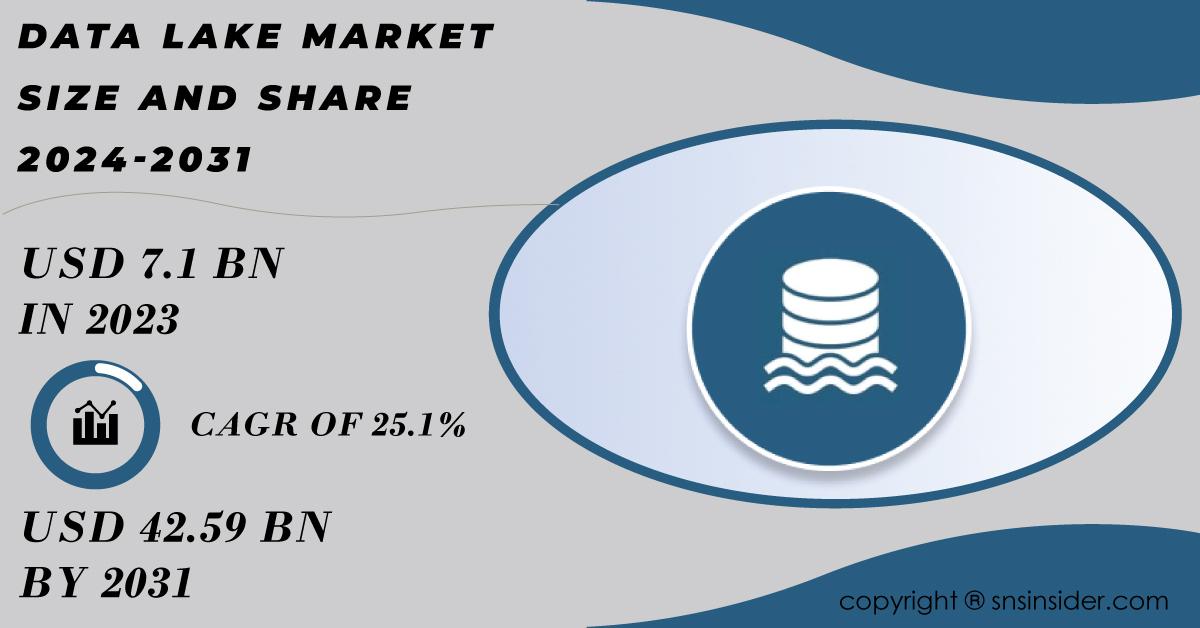
Data Lake Market Scope and Overview
The Data Lake Market represents a pivotal evolution in data management, enabling organizations to harness vast amounts of structured and unstructured data for analytics and decision-making. This report delves into various facets of the data lake market, including competitive analysis, market segmentation, regional outlook, key growth drivers, market strengths, impact of the recession, and concluding insights.
A data lake serves as a centralized repository that stores large volumes of raw data in its native format until needed for analysis. Unlike traditional data warehouses, data lakes accommodate diverse data types, including structured, semi-structured, and unstructured data, providing flexibility and scalability for big data analytics. Organizations across industries leverage data lakes to derive actionable insights, improve operational efficiencies, enhance customer experiences, and drive innovation through advanced analytics, machine learning, and AI applications.
Competitive Analysis
The data lake market is characterized by intense competition among major technology companies and specialized providers offering comprehensive data lake solutions. Key players include Teradata, Cloudera, Dremio, Microsoft, Snowflake, Zaloni, Oracle Corporation, IBM Corporation, Informatica, AWS, and others. These companies compete based on factors such as scalability, performance, security, integration capabilities, and support for advanced analytics and AI-driven insights. Competitive strategies focus on product innovation, strategic partnerships, cloud integration, and enhancing data governance and security frameworks.
Data Lake Market Segmentation Analysis
Understanding market segmentation is crucial for tailoring data lake solutions to meet specific industry needs and organizational requirements.
By Deployment
- On-Premise: On-premise data lakes are deployed within an organization’s physical infrastructure, providing full control over data storage, security, and compliance. They are preferred by enterprises with stringent data governance policies, regulatory requirements, and legacy IT environments.
- Cloud Based: Cloud-based data lakes leverage cloud computing platforms such as AWS, Microsoft Azure, and Google Cloud Platform (GCP) to store and manage data. They offer scalability, cost-efficiency, and agility, enabling organizations to quickly scale resources, integrate with other cloud services, and leverage pay-as-you-go pricing models.
By Enterprise Type
- Large Enterprises: Large enterprises typically deploy data lakes to manage vast volumes of data generated from multiple sources and departments. They leverage data lakes for enterprise-wide analytics, real-time insights, and strategic decision-making across business functions.
- Small & Medium-Sized Enterprises (SMEs): SMEs adopt data lakes to gain competitive advantages through data-driven insights, cost-effective scalability, and improved operational efficiencies. Cloud-based data lake solutions cater to SMEs by eliminating the need for substantial upfront investments in infrastructure and IT resources.
By Business Function
- Marketing: Marketing departments utilize data lakes to analyze customer behavior, preferences, and interactions across digital channels. Data-driven marketing strategies leverage insights derived from data lakes to personalize customer experiences, optimize campaigns, and drive customer acquisition and retention.
- HR: Human resources departments leverage data lakes for workforce analytics, talent management, employee performance insights, and predictive modeling. Data lakes enable HR teams to make informed decisions regarding recruitment, retention strategies, training programs, and organizational development.
- Operations: Operations teams utilize data lakes for real-time monitoring, process optimization, supply chain management, and predictive maintenance. Data-driven insights derived from data lakes help streamline operations, enhance efficiency, reduce costs, and improve overall business agility.
- Finance: Finance departments leverage data lakes for financial analytics, risk management, fraud detection, and compliance reporting. Data lakes enable CFOs and finance professionals to gain holistic views of financial performance, forecast trends, and make data-driven decisions to drive business growth.
By Industry
- IT & Telecom: The IT & Telecom industry utilizes data lakes to analyze network performance, customer data, and operational metrics. Data lakes facilitate predictive analytics for customer churn prediction, network optimization, and personalized service offerings.
- BFSI (Banking, Financial Services, and Insurance): BFSI sectors leverage data lakes for risk management, fraud detection, customer segmentation, and regulatory compliance. Data lakes enable financial institutions to analyze transactional data, market trends, and customer behavior to drive personalized banking experiences and mitigate risks.
- Retail & E-commerce: Retailers and e-commerce platforms use data lakes to analyze customer purchase patterns, inventory management, pricing strategies, and supply chain optimization. Data-driven insights from data lakes enable retailers to enhance customer experiences, optimize product assortments, and drive sales growth.
- Healthcare & Life Sciences: Healthcare organizations leverage data lakes for clinical analytics, patient outcomes research, personalized medicine, and population health management. Data lakes integrate diverse healthcare data sources, such as electronic health records (EHRs), genomic data, and medical imaging, to improve healthcare delivery and patient care.
- Manufacturing: Manufacturers utilize data lakes for predictive maintenance, quality control, supply chain visibility, and production optimization. Data lakes enable manufacturers to monitor equipment performance, detect anomalies, and improve operational efficiency across production processes.
- Energy & Utilities: Energy and utility companies leverage data lakes for smart grid analytics, energy consumption forecasting, asset management, and regulatory compliance. Data lakes integrate IoT sensor data, weather patterns, and operational metrics to optimize energy distribution, reduce downtime, and enhance grid reliability.
- Others: Other industries, including education, government, media & entertainment, and transportation, also adopt data lakes for diverse applications such as student analytics, public sector efficiency, content personalization, and logistics optimization.
Regional Outlook
The adoption of data lakes varies across regions, influenced by factors such as technological infrastructure, regulatory environment, data privacy laws, and industry-specific demands.
North America leads the global data lake market, driven by the presence of tech giants, widespread adoption of cloud computing, and a robust ecosystem of data-driven enterprises. The region emphasizes innovation in AI, machine learning, and big data analytics across various industries.
Europe follows closely, with countries like the UK, Germany, and France investing in data privacy regulations, digital transformation initiatives, and AI-driven analytics solutions. European enterprises leverage data lakes to comply with GDPR regulations, enhance customer insights, and drive business agility.
The Asia-Pacific region is witnessing rapid growth in data lake adoption, fueled by expanding internet penetration, digital transformation initiatives, and the proliferation of IoT devices. Countries like China, India, and Japan are investing in cloud infrastructure and AI technologies to harness big data for economic growth, innovation, and competitive advantage.
Latin America is emerging as a promising market for data lakes, driven by increasing digitalization, government initiatives for smart city development, and data-driven decision-making in sectors such as healthcare, finance, and energy.
The Middle East and Africa are exploring data lake solutions to address regional challenges in healthcare, education, infrastructure management, and economic diversification. Governments and enterprises are investing in digital infrastructure and AI-driven analytics to drive sustainable development and innovation.
Key Growth Drivers of the Data Lake Market
Several factors are driving the growth of the data lake market globally:
- The proliferation of digital data from IoT devices, social media platforms, mobile applications, and enterprise systems fuels demand for data lake solutions capable of storing, managing, and analyzing massive datasets.
- Organizations leverage data lakes for advanced analytics, predictive modeling, machine learning, and AI-driven insights to uncover hidden patterns, improve decision-making, and gain competitive advantages in their respective industries.
- Increasing adoption of cloud computing platforms, such as AWS, Azure, and Google Cloud, accelerates data lake deployments by offering scalability, agility, cost-efficiency, and seamless integration with other cloud services and applications.
- Enterprises prioritize data-driven decision-making processes that rely on real-time insights derived from data lakes to enhance operational efficiency, innovate products/services, personalize customer experiences, and optimize business strategies.
- Stringent data privacy regulations and compliance requirements, such as GDPR in Europe and CCPA in California, drive the adoption of data lakes with robust data governance, encryption, and access control mechanisms to protect sensitive information.
Strengths of the Data Lake Market
The data lake market exhibits several strengths that contribute to its growth and resilience:
- Data lakes offer scalability to accommodate growing data volumes and flexibility to ingest, store, and process diverse data types, including structured, semi-structured, and unstructured data, supporting various analytics and AI applications.
- Cloud-based data lake solutions reduce capital expenditures on IT infrastructure, maintenance, and storage, allowing enterprises to scale resources based on demand and optimize operational costs.
- Data lakes integrate seamlessly with existing IT ecosystems, analytics tools, business intelligence platforms, and AI frameworks, enabling enterprises to leverage existing investments and enhance interoperability across systems.
- Data lakes support real-time data ingestion and analytics, empowering enterprises to gain immediate insights, detect anomalies, respond to market trends, and capitalize on business opportunities faster than traditional data processing methods.
Impact of the Recession
The global recession has underscored the importance of data-driven decision-making and operational efficiency, driving enterprises to accelerate digital transformation initiatives, including the adoption of data lake solutions. While budget constraints may temporarily slow down IT investments, organizations prioritize cost-effective cloud-based data lake solutions that offer scalability, agility, and operational efficiencies to navigate economic uncertainties, drive innovation, and maintain competitive advantage.
Key Objectives of the Data Lake Market Research Report
The market research report on the data lake market aims to achieve several key objectives:
- Provide insights into market size, growth trends, and competitive landscape across different segments, regions, and industry verticals leveraging data lakes.
- Evaluate the strategies, product portfolios, and market positions of key players in the data lake ecosystem, identifying strengths, weaknesses, opportunities, and threats (SWOT analysis).
- Offer detailed segmentation analysis based on deployment models (on-premise, cloud-based), enterprise types (large enterprises, SMEs), business functions (marketing, HR, operations, finance), and industry verticals (IT & Telecom, BFSI, retail & e-commerce, healthcare & life sciences, manufacturing, energy & utilities, others).
- Assess regional variations in data lake adoption, regulatory environments, competitive dynamics, and industry-specific use cases, providing insights into market expansion strategies and growth opportunities.
- Analyze emerging technologies, such as AI, machine learning, real-time analytics, and IoT integration, influencing the evolution of data lake solutions and driving market innovation.
- Provide forecasts for market growth, emerging trends, technological advancements, and regulatory developments shaping the future of the data lake market, enabling stakeholders to anticipate industry shifts and formulate strategic initiatives.
Conclusion
The data lake market represents a transformative approach to data management, enabling enterprises to harness the power of big data for actionable insights, innovation, and competitive advantage. As organizations across industries embrace digital transformation and prioritize data-driven decision-making, data lakes play a pivotal role in enabling scalable, flexible, and cost-effective solutions for managing, analyzing, and deriving value from diverse datasets. By understanding market dynamics, leveraging advanced analytics capabilities, and embracing cloud-based solutions, enterprises can navigate the complexities of the data-driven economy, drive operational efficiencies, and unlock new opportunities for growth and innovation in a rapidly evolving market landscape.
Table of Contents
- Introduction
- Industry Flowchart
- Research Methodology
- Market Dynamics
- Impact Analysis
- Impact of Ukraine-Russia war
- Impact of Economic Slowdown on Major Economies
- Value Chain Analysis
- Porter’s 5 Forces Model
- PEST Analysis
- Data Lake Market Segmentation, By Deployment
- Data Lake Market Segmentation, By Enterprise Type
- Data Lake Market Segmentation, By Business Function
- Data Lake Market Segmentation, By Industry
- Regional Analysis
- Company Profile
- Competitive Landscape
- USE Cases and Best Practices
- Conclusion
Contact Us:
Akash Anand – Head of Business Development & Strategy
info@snsinsider.com
Phone: +1-415-230-0044 (US) | +91-7798602273 (IND)
About Us
SNS Insider is one of the leading market research and consulting agencies that dominates the market research industry globally. Our company’s aim is to give clients the knowledge they require in order to function in changing circumstances. In order to give you current, accurate market data, consumer insights, and opinions so that you can make decisions with confidence, we employ a variety of techniques, including surveys, video talks, and focus groups around the world.
Read Our Other Reports:
Artificial Intelligence in Accounting Market Analysis
