


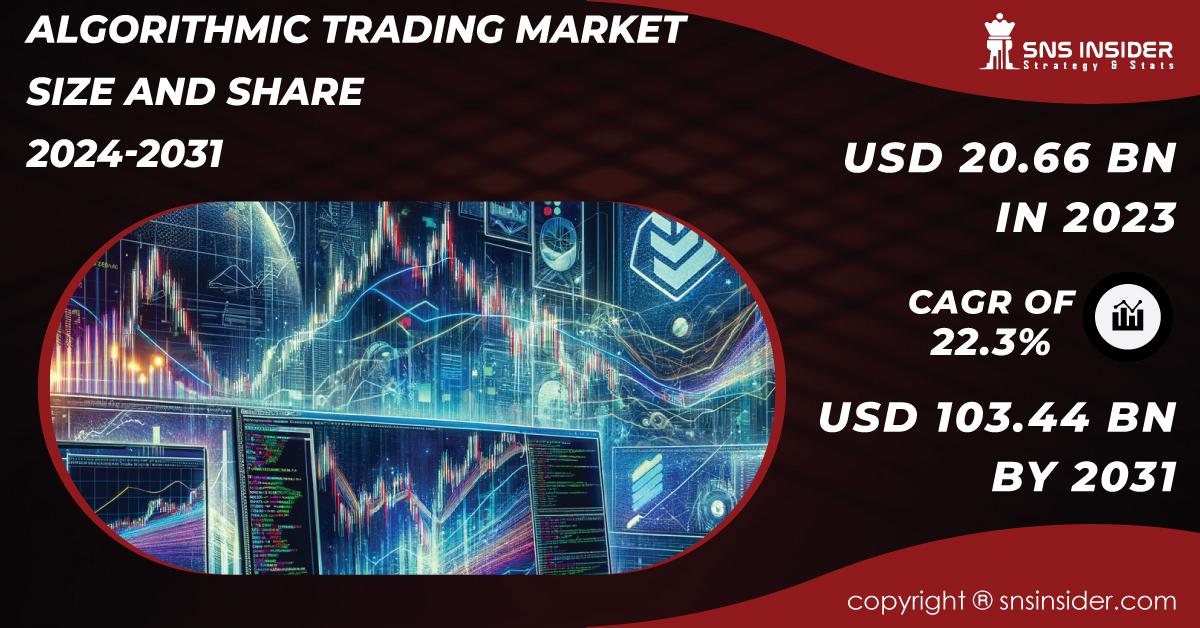
Algorithmic Trading Market Scope and Overview
The Algorithmic Trading Market has revolutionized financial markets by leveraging advanced algorithms and computing power to execute trading strategies with speed and efficiency. Algorithmic trading, also known as algo trading or black-box trading, involves the use of automated systems to place trades based on predefined criteria such as price, volume, and timing. This report explores the dynamics of the algorithmic trading market, including competitive analysis, market segmentation, regional outlook, key growth drivers, strengths, impact of the recession, and conclusions.
The Algorithmic Trading market involves the use of computer algorithms to execute trades in financial markets at high speeds and volumes. These algorithms analyze market data and trends to make informed trading decisions, often without human intervention. Algorithmic trading is used by institutional investors, hedge funds, and proprietary trading firms to optimize trade execution, reduce transaction costs, and capitalize on market opportunities. The market is characterized by its reliance on advanced technologies, including artificial intelligence and machine learning, to enhance trading strategies and performance.
Competitive Analysis
The algorithmic trading market is highly competitive, driven by technological advancements and the need for faster and more efficient trading strategies. Key players in this market include 63 moons technologies limited, Tata Consultancy Services Limited, Algo Trader, Symphony, Argo Software Engineering, Refinitiv, InfoReach, Inc., Kuberre Systems, Inc., MetaQuotes Ltd., VIRTU Finance Inc, and others. These companies offer a range of solutions and services aimed at enhancing trading efficiency, reducing transaction costs, and maximizing returns for traders and financial institutions. Competition is fierce as players innovate with new algorithms, enhance platform capabilities, and expand their global reach through strategic partnerships and acquisitions.
Algorithmic Trading Market Segmentation
By Solution
- Platforms: Algorithmic trading platforms provide the infrastructure and tools for developing and deploying trading algorithms. These platforms offer features such as real-time market data, backtesting capabilities, and connectivity to multiple exchanges. They cater to both institutional and retail traders looking to automate their trading strategies efficiently.
- Software Tools: Software tools in algorithmic trading include algorithm development environments, execution management systems (EMS), and trading analytics software. These tools enable traders to design, test, and optimize algorithms based on market conditions and trading objectives. They are essential for implementing complex trading strategies and managing risk effectively.
By Service
- Professional Services: Professional services in algorithmic trading encompass consulting, strategy development, algorithm customization, and implementation support. These services are tailored to meet the specific needs of financial institutions and hedge funds seeking to optimize their trading operations and achieve competitive advantages in the market.
- Managed Services: Managed services providers offer outsourced solutions for algorithmic trading, including hosting, monitoring, and maintenance of trading algorithms. These services enable firms to focus on their core business while leveraging the expertise of service providers to manage trading infrastructure and ensure optimal performance.
By Deployment
- Cloud: Cloud-based deployment of algorithmic trading solutions offers scalability, flexibility, and cost-efficiency. Cloud platforms provide access to computing resources and data storage on-demand, allowing traders to deploy and scale algorithms quickly without significant upfront investment in infrastructure.
- On-premise: On-premise deployment involves installing and maintaining algorithmic trading software and infrastructure within the organization’s premises. This deployment model offers greater control over data security and customization options but may require higher initial investment and IT resources.
By Trading Types
- Foreign Exchange (FOREX): Algorithmic trading is widely used in the foreign exchange market for executing currency trades based on pre-defined algorithms. High liquidity and round-the-clock trading make FOREX a popular choice for algorithmic trading strategies aimed at capitalizing on price fluctuations and market inefficiencies.
- Stock Markets: Algorithmic trading strategies are prevalent in stock markets, where high-frequency trading (HFT) algorithms execute large volumes of trades at high speeds. These algorithms aim to capitalize on price discrepancies, market trends, and other quantitative signals to generate profits for traders and investors.
- Exchange-Traded Fund (ETF): ETF trading involves algorithmic strategies designed to track or outperform benchmark indices by adjusting portfolio holdings based on market conditions. Algorithmic trading enhances liquidity in ETF markets and provides investors with efficient ways to gain exposure to diversified asset classes.
- Bonds: Algorithmic trading in bond markets focuses on automating bond pricing, trading, and risk management processes. These algorithms analyze bond yields, credit ratings, and economic indicators to execute trades that maximize returns and manage interest rate risks effectively.
- Cryptocurrencies: The cryptocurrency market has seen a surge in algorithmic trading activity, driven by the volatility and 24/7 trading nature of digital assets. Algorithms in this market aim to capitalize on price differentials across multiple exchanges and enhance liquidity for traders and investors.
- Others: Other trading types include commodities, options, futures, and derivatives, where algorithmic trading strategies are used to optimize trading decisions, reduce transaction costs, and manage portfolio risks.
By Type of Traders
- Institutional Investors: Institutional investors such as banks, asset management firms, and hedge funds use algorithmic trading to execute large-volume trades efficiently and at optimal prices. These investors leverage algorithmic strategies to manage portfolios, mitigate risks, and enhance returns for their clients.
- Long-term Traders: Long-term traders employ algorithmic trading to implement buy-and-hold strategies based on fundamental analysis and market trends. These algorithms aim to identify undervalued assets, diversify portfolios, and achieve long-term investment objectives.
- Short-term Traders: Short-term traders, including day traders and scalpers, utilize algorithmic trading for executing rapid trades based on technical indicators, price movements, and market volatility. These strategies aim to capitalize on short-term price fluctuations and generate quick profits in volatile markets.
- Retail Investors: Retail investors increasingly use algorithmic trading platforms and tools to automate their trading activities and gain access to sophisticated trading strategies. Algorithmic trading empowers retail investors to execute trades efficiently, manage risks, and participate in financial markets alongside institutional traders.
Regional Outlook
The algorithmic trading market exhibits robust growth across different regions, driven by technological advancements, regulatory developments, and increasing adoption of automated trading strategies. North America dominates the market, led by the United States, which houses a significant number of key players and financial institutions leveraging algorithmic trading for competitive advantage. The region benefits from advanced infrastructure, favorable regulatory environment, and high adoption of financial technologies.
Europe follows closely, driven by major financial centers such as the UK, Germany, and Switzerland, where algorithmic trading is integral to capital markets and investment strategies. The European Union’s regulatory framework, including MiFID II, promotes transparency and competition in financial markets, supporting the growth of algorithmic trading activities.
Asia-Pacific is experiencing rapid growth in algorithmic trading, particularly in countries like Japan, China, and Australia, fueled by increasing investments in financial technology and electronic trading platforms. Emerging economies in Southeast Asia are also witnessing rising adoption of algorithmic trading solutions as financial markets mature and regulatory environments evolve.
Latin America and the Middle East & Africa are emerging as promising markets for algorithmic trading, driven by expanding financial sectors, technological advancements, and growing investor participation in capital markets. These regions present opportunities for algorithmic trading firms to expand their footprint and cater to diverse trading needs across various asset classes.
Key Growth Drivers of the Algorithmic Trading Market
Several factors are driving the growth of the Algorithmic Trading market:
- Continuous advancements in AI, machine learning, and big data analytics enhance the capabilities of algorithmic trading systems, enabling faster decision-making, improved predictive accuracy, and efficient trade execution.
- Regulatory developments, such as MiFID II in Europe and SEC regulations in the United States, promote transparency, fairness, and risk management in financial markets, driving the adoption of algorithmic trading solutions.
- Algorithmic trading reduces transaction costs by minimizing slippage and optimizing trade execution based on predefined parameters, making it cost-effective for institutional and retail traders alike.
- Algorithmic trading enhances market liquidity by providing continuous trading activity and narrowing bid-ask spreads, which benefits investors by improving price discovery and reducing trading risks.
- Automated risk management features in algorithmic trading systems help mitigate operational risks, monitor compliance with trading rules, and manage portfolio risks effectively, enhancing overall investment performance.
Strengths of the Algorithmic Trading Market
The Algorithmic Trading market possesses several strengths that contribute to its growth and resilience:
- Algorithmic trading systems execute trades at high speeds with minimal latency, enabling traders to capitalize on market opportunities and respond to price fluctuations in real-time.
- Algorithmic trading platforms and tools are scalable, allowing firms to handle large volumes of trades and expand their trading operations without significant infrastructure investment.
- Algorithmic trading strategies cover a wide range of asset classes and trading types, providing investors with diversified investment opportunities and risk management capabilities.
- Market players continuously innovate with new algorithms, trading strategies, and technological solutions to meet evolving market demands and enhance trading efficiency.
- Algorithmic trading firms operate globally, providing access to major financial markets and enabling seamless cross-border trading activities for institutional and retail investors.
Impact of the Recession
The global economic recession has had a nuanced impact on the Algorithmic Trading market. On one hand, market volatility and uncertainty have increased trading opportunities, driving demand for algorithmic trading strategies that capitalize on price fluctuations and market inefficiencies. On the other hand, economic downturns can reduce trading volumes, liquidity, and investor confidence, affecting the profitability of algorithmic trading firms and prompting cautious investment strategies.
Key Objectives of the Market Research Report
The primary objectives of the Algorithmic Trading market research report include:
- Providing a comprehensive analysis of market size, growth trends, and competitive landscape across different regions and segments.
- Offering detailed insights into market segmentation by solution, service, deployment, trading type, and type of traders, highlighting growth opportunities and market dynamics in each segment.
- Assessing the competitive environment, including key players, their market share, strategies, and technological innovations.
- Evaluating regional market dynamics, regulatory environments, and economic factors influencing market growth in North America, Europe, Asia-Pacific, Latin America, and the Middle East & Africa.
- Analyzing the impact of technological advancements, regulatory changes, economic conditions, and market trends on the Algorithmic Trading market.
- Forecasting market trends, growth prospects, and investment opportunities for stakeholders, based on emerging technologies, regulatory developments, and market dynamics.
Conclusion
In conclusion, the Algorithmic Trading market continues to evolve rapidly, driven by technological advancements, regulatory reforms, and increasing adoption across global financial markets. Key players such as 63 moons technologies limited, Tata Consultancy Services Limited, Algo Trader, and others are innovating with advanced algorithms, software tools, and managed services to cater to the diverse needs of institutional and retail traders. While challenges such as regulatory compliance and market volatility persist, the market’s strengths in efficiency, scalability, and innovation position it for sustained growth. As algorithmic trading becomes integral to modern investment strategies, stakeholders must navigate opportunities and challenges to capitalize on emerging trends and drive future market expansion.
Table of Contents
- Introduction
- Industry Flowchart
- Research Methodology
- Market Dynamics
- Impact Analysis
- Impact of Ukraine-Russia war
- Impact of Economic Slowdown on Major Economies
- Value Chain Analysis
- Porter’s 5 Forces Model
- PEST Analysis
- Algorithmic Trading Market Segmentation, by Solution
- Algorithmic Trading Market Segmentation, by Service
- Algorithmic Trading Market Segmentation, by Deployment
- Algorithmic Trading Market Segmentation, by Trading Types
- Algorithmic Trading Market Segmentation, by Type of Traders
- Regional Analysis
- Company Profile
- Competitive Landscape
- USE Cases and Best Practices
- Conclusion
Contact Us:
Akash Anand – Head of Business Development & Strategy
info@snsinsider.com
Phone: +1-415-230-0044 (US) | +91-7798602273 (IND)
About Us
SNS Insider is one of the leading market research and consulting agencies that dominates the market research industry globally. Our company’s aim is to give clients the knowledge they require in order to function in changing circumstances. In order to give you current, accurate market data, consumer insights, and opinions so that you can make decisions with confidence, we employ a variety of techniques, including surveys, video talks, and focus groups around the world.
Read Our Other Reports:
Voice Biometrics Market Forecast
Direct Carrier Billing Industry
